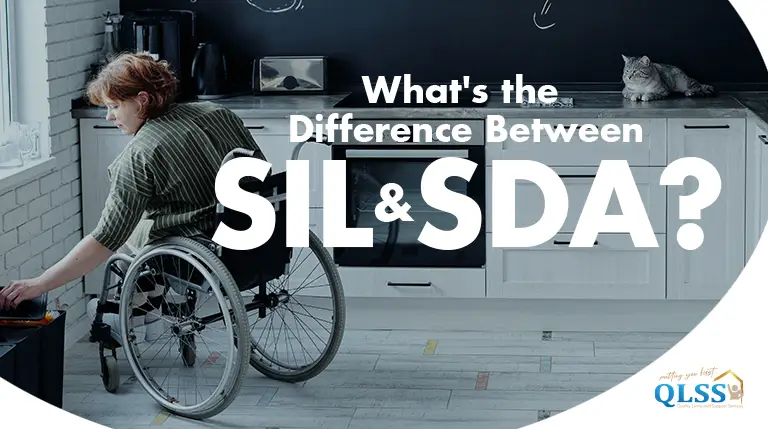
If you’re exploring NDIS housing options, you’ve probably come across the terms Supported Independent Living (SIL) and Specialist Disability Accommodation (SDA).
They’re often mentioned together, which can make it seem like they’re the same thing. In reality, SIL and SDA are two completely different types of NDIS supports that serve different purposes.
Understanding the difference can help participants, families and Support Coordinators make better decisions about housing and support arrangements.
The Easy Explanation
The easiest way to understand the difference is:
- SIL is the in-person support you receive.
- SDA is specifically the purpose-built home you live in.
A participant may have NDIS funding for:
- SIL services only
- an SDA property only
- both an SDA home with SIL services.
The right option depends entirely on the person’s individual support and housing needs.
What is Supported Independent Living (SIL)?
Supported Independent Living (SIL) is funding that helps participants receive support with daily living activities so they can live as independently as possible.
SIL is generally designed for people who require significant ongoing support throughout the day and, in some cases, overnight.
Depending on individual needs, SIL may include support with:
- Personal care
- Showering and dressing
- Meal preparation
- Household tasks
- Medication support
- Building independent living skills
- Accessing the community
- Developing daily routines
Importantly, SIL does not pay for accommodation. It funds the support workers and assistance a participant receives, regardless of where they live.
Example of SIL
A participant lives in a shared home with two other NDIS participants. They need support throughout the day with personal care, cooking and household tasks.
The NDIS funds the support workers through SIL, while the participants still contribute towards their housing and everyday living costs.
In this example, the participant has SIL funding, but not necessarily SDA funding.
What is Specialist Disability Accommodation (SDA)?
Specialist Disability Accommodation (SDA) is funding for purpose-built housing designed for people with very high support needs or extreme functional impairment.
SDA focuses on the physical property itself rather than the support provided inside the home.
These homes may include features such as:
Wheelchair-accessible layouts
Wide doorways and hallways
Ceiling hoists
Accessible bathrooms and kitchens
Assistive technology
Enhanced safety features
Designs tailored to complex physical support needs
SDA funding contributes towards the cost of providing and maintaining these specialist homes.
Unlike SIL, SDA does not fund support workers or daily care services.
Example of SDA
A participant with significant mobility requirements lives in a purpose-built accessible apartment with ceiling hoists and specialised bathroom equipment.
They are largely independent and only require minimal support each day. In this situation, the participant may have SDA funding without SIL funding.
How QLSS Can Help
Understanding housing and support options under the NDIS can feel overwhelming, especially when different funding categories are involved.
At QLSS, we work with participants, families and Support Coordinators to help identify suitable living arrangements that support independence, wellbeing and quality of life.
Whether you’re considering Supported Independent Living, exploring Specialist Disability Accommodation, or simply trying to understand your options, our team can help you navigate the process with confidence.
Final Thoughts
While SIL and SDA are often spoken about together, they serve very different purposes. Understanding this distinction can help you make informed decisions about your NDIS plan and ensure both your support needs and housing needs are properly considered.
If you’re unsure which option may be suitable for your situation, speaking with an experienced provider or Support Coordinator can be a great place to start. Contact us today for more assistance.