

A practical guide to what they are, why they matter, and how they support your NDIS plan.
If you are involved in the NDIS – whether as a participant, family member, support coordinator or service provider – you may have heard the term Functional Capacity Assessment (FCA). While it sounds technical, it is actually a very practical and important part of understanding a person’s support needs.
A FCA helps explain how a person manages everyday activities and where they may need support. It is one of the key tools used within the NDIS to ensure funding reflects a person’s real-world needs, not just their medical diagnosis.
Understanding what an FCA involves can make the process feel less overwhelming and help you feel more prepared if one is recommended for you or someone you support.
What Is a FCA?
A FCA is a detailed evaluation of how a person is able to complete everyday tasks across different areas of life.
It is usually completed by an allied health professional such as an Occupational Therapist, although in some cases other clinicians may be involved depending on the situation.
The assessment looks at what a person can do independently, what they need assistance with, and what barriers may be impacting their ability to participate in daily life.
Rather than focusing solely on diagnosis or medical history, an FCA focuses on function – that is, how someone actually manages in their day-to-day environment.
What Areas Does a FCA Look At?
FCA’s usually explore a range of life domains to build a full picture of a person’s abilities and support needs.
These may include personal care activities such as showering, dressing, eating, and maintaining hygiene. They also look at domestic tasks like cooking, cleaning, laundry, and managing a home environment.
Beyond daily living tasks, an FCA may assess mobility and physical function, including how a person moves around their home and community. Cognitive and communication abilities are also considered, such as memory, decision-making, planning, understanding instructions, and interacting with others.
Participation in the community is another important area. This might include using transport, attending appointments, engaging in social activities, or accessing education or employment.
Each assessment is tailored to the individual, so not every FCA will look exactly the same. The focus is always on the areas that are relevant to the person’s goals and circumstances.
Why Are FCA’s Important?
FCA’s play a key role in the NDIS because they provide evidence-based information about a person’s support needs.
The NDIS uses FCA’s to help determine what funding and supports are reasonable and necessary. This means the assessment helps show not just what diagnosis someone has, but how that diagnosis impacts their ability to function in everyday life.
For example, two people may have the same diagnosis but very different levels of independence. An FCA helps highlight those differences so that funding can be tailored appropriately.
They are also important during plan reviews, especially if there has been a change in circumstances, such as a decline in function, a transition into adulthood, or new support needs emerging over time.
When Might You Need an FCA?
A FCA may be recommended in several situations.
One of the most common times is when a person is applying for the NDIS for the first time. The assessment helps demonstrate eligibility and support requirements by providing clear evidence of functional impact.
It is also often used during plan reviews, particularly when there is a request for increased funding, new types of supports, or changes to existing services.
If someone is requesting assistive technology, home modifications, or Supported Independent Living (SIL), an FCA is often required to support the application.
In some cases, an FCA may also be completed when there is uncertainty about the level of support needed. This helps ensure the right supports are put in place rather than under- or over-estimating what is required.
What Happens During an FCA?
 A FCA is usually completed over one or more sessions, depending on the complexity of a person’s needs.
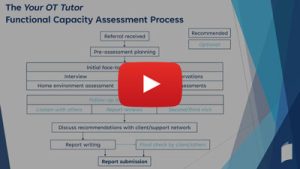
The process typically begins with a conversation about daily life, routines, challenges, and goals. The clinician may ask questions about how you manage tasks at home, at school, at work, or in the community.
They may also observe certain activities or ask you to demonstrate how you complete specific tasks. This is not about testing or judging performance—it is about understanding real-life function.
In many cases, the clinician will also speak with family members, carers, or support workers (with consent) to gain a broader understanding of how support is provided day-to-day.
After gathering this information, the clinician prepares a detailed report.
What Is Included in the Report?
The FCA report is a key outcome of the process.
It usually includes a summary of the person’s background and current supports, along with an overview of their functional abilities across different life areas.
Importantly, it outlines both strengths and challenges. This balanced approach helps ensure the report reflects the person as a whole, not just areas of difficulty.
The report will also include recommendations. These may relate to therapy supports, assistive technology, home modifications, skill development programs, or levels of support required.
For NDIS purposes, the report helps justify funding requests by linking functional impact to specific supports.
How Is an FCA Different From a Diagnosis?
A diagnosis tells you what condition someone has, while an FCA explains how that condition affects daily life.
This distinction is important because the NDIS does not fund supports based on diagnosis alone. Instead, funding is based on functional impact and individual support needs.
For example, two people with the same diagnosis may have very different levels of independence. One may require minimal support, while another may need assistance throughout the day. An FCA helps clearly demonstrate these differences.
Who Completes an FCA?
 FCA’s are most commonly completed by Occupational Therapists, as they are trained to assess how people function in daily activities and environments.
However, depending on the situation, other allied health professionals such as psychologists, speech pathologists, or physiotherapists may contribute to parts of the assessment.
The most appropriate clinician will depend on the person’s needs and the type of information required for the NDIS or other systems.
This video outlines the process the clinicians would usually follow for an FCA.
How Long Does It Take?
The length of time required for an FCA can vary significantly. Some assessments may be completed in a single session followed by report writing, while more complex cases may require multiple sessions over several weeks.
The report itself can also take time to prepare, as it must include detailed analysis and evidence-based recommendations.
While the process may feel lengthy, the information gathered is often critical in ensuring appropriate supports are funded and delivered.
Common Misconceptions
One common misconception is that an FCA is only required for people with high support needs. In reality, FCA’s can be useful at many different levels of ability, particularly when clarity is needed about support requirements.
Another misconception is that the assessment is a pass or fail test. In fact, there is no “pass” or “fail” – the purpose is simply to understand function and support needs.
Some people also worry that the assessment will focus only on limitations. However, a good FCA highlights strengths as well as challenges, which is essential for building a balanced support plan.
Get the Right Supports
An FCA is a key tool within the NDIS that helps ensure participants receive the right supports based on their actual day-to-day needs.
While the process can seem complex at first, it is ultimately about telling your story in a structured and evidence-based way so that your supports reflect your real-life situation.
When done well, an FCA provides clarity, direction, and a strong foundation for building a meaningful and effective NDIS plan.
Need help with a Functional Capacity Assessment?
If you are an NDIS participant and think you may need a Functional Capacity Assessment, our Support Coordination team can help connect you with experienced allied health professionals and support you through the process of understanding and using your results. For assistance, contact us today.